TL;DR: Go into the next year as prepared as you tell your clients to be. Reflect on this year’s marketing before you plan for next year. Look at what brought in clients, and how you can expand on that. Then cut or simplify what didn’t resonate well with your audience.
You coach clients to gather data on their performance, contributions, challenges, and wins throughout the year. But every Q4, you’re slammed with client reviews, contract renewals, budget conversations, and holiday slowdowns, so you miss auditing your marketing. You know you should review your marketing and use the data to build your strategy for next year, but you can’t seem to make the time.
Another scenario I often see is leadership coaches concluding they have enough leads or referrals, so they don’t need a full picture of their marketing. But what would you say to a high performer who says, “My work speaks for itself,” and skips the self-review? You know they’ll miss valuable insights if they skip it.
Let’s make it easy this year: a marketing review plan that will take under two hours. Open a blank doc and all of your marketing sites: LinkedIn, website, email provider, etc. Now, let’s get started.

Where did your clients actually come from this year?
We want to know the journey from when they first learned you exist to when they hired you. List every paying client this year and how they found you. Was it an email, past client referral, peer referral, LinkedIn, or somewhere else?
If you see most of your list came from referrals, great! But don’t end the marketing review there. What kind of referrals did you get? Did they look you up before they reached out? Many referrals check your website and LinkedIn before they book. Ask new clients what they saw or read before they reached out.
We want to know how many touchpoints you’ve had with a lead, including referrals, and how many converted into paying clients.
Close rate = proposals closed ÷ proposals sent × 100.
Call-to-proposal rate = proposals sent ÷ discovery calls × 100
Lead conversion rate = new paying clients ÷ total leads × 100
Note: With small numbers, the direction matters more than the exact percentage. If you have eight clients a year, you will see big swings.
Who's paying attention, and are they potential clients?
Your biggest fan on LinkedIn may never hire you. Some fans genuinely love your work. Others comment on everything to put their name in front of your audience. Either way, they aren’t the data we want.
The same is true of peers. Leadership coaches are generous with each other. They comment on each other’s posts, repost them, and sign up for each other’s newsletters. But they aren’t hiring you. For this review, focus on attention from people who could become paying clients.
Who is an ideal client that said “me too” on your post or DM? Were you attracting the types of leaders or hiring managers you want to work with?
Were you consistent? If not, why?
Ask yourself this question like you’d ask a client who missed a goal. Lead with curiosity, not judgment. If you were consistent, you’ll want to know how so you can lean into that.
Notice where you showed up regularly: LinkedIn posting, LinkedIn newsletter, blog, podcast, newsletters, and any other place you’re marketing. What made it easy to stay consistent where you did? What made it hard to show up where you weren’t?
Was the plan too big? Did someone advise you to try a certain platform and now you’re juggling too many? Did your coaching calendar fill up, leaving no time for strategic marketing? Was there no system?
Inconsistency also skews the data: a post may have “flopped” because it followed a three-week gap, not because the topic was wrong.
Next year, lean into what’s easier: one blog post or podcast that becomes four LinkedIn posts, or staying two weeks ahead with content ready to publish.
LinkedIn Follower Demographic
You’ll want to know who is following you, their demographics, and how your count has increased or stayed the same.
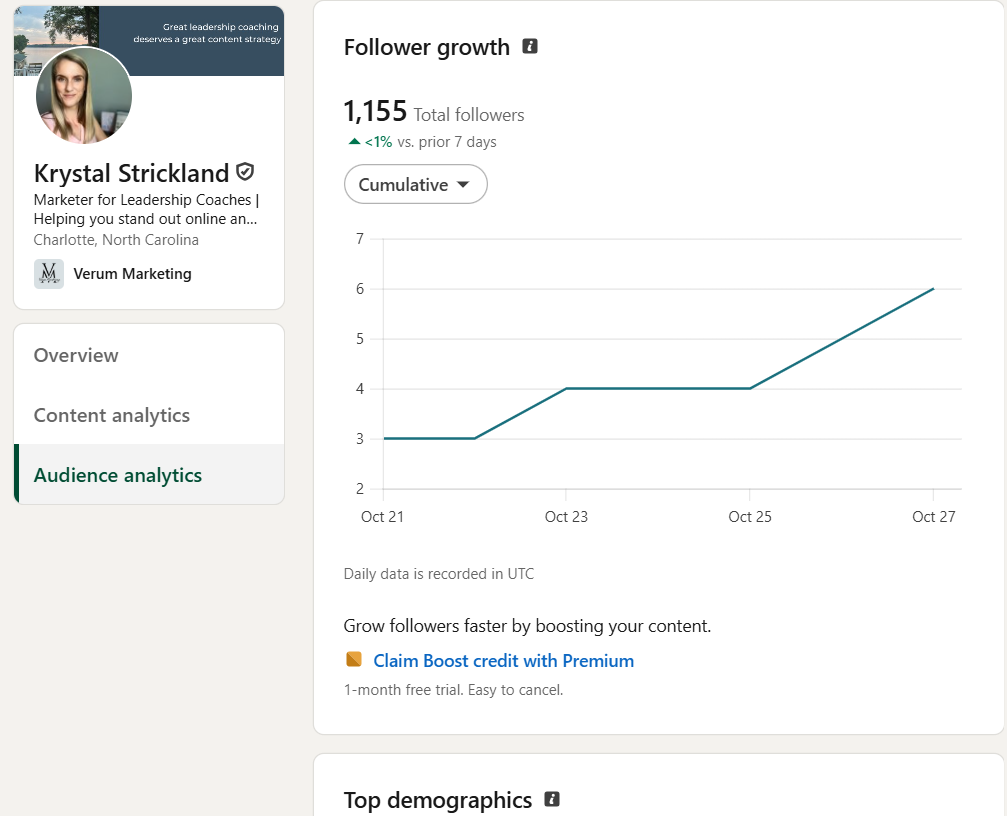
Your profile ➡️ Scroll down to analytics ➡️ Show All ➡️ Overview (you’ll be there by default) ➡️ Click Audience Analytics ➡️ Scroll down to Top Demographics.
Here, you want to look at job title, seniority, industry, and any other metric that’s important to your coaching practice.
Look back through your DMs to see who you’ve talked to.
Profile Views
Profile views help us understand whether the right people are looking at your profile, which is usually the step before they leave LinkedIn to connect with you on your website.
Your profile ➡️ Scroll down to analytics ➡️ Show All ➡️ Overview (you’ll be there by default) ➡️Under Track Performance, click profile viewers.
Were any of them potential clients? A director who viewed your profile twice is worth sending a connection request to. Without Premium, you’ll see titles and locations but not always names, so you may need to search for them.
Note: Peer attention signals credibility, but if coaches outnumber leaders, you may be writing in coach language rather than your clients’ language.
Topics that are Landing (or not)
You’ll want to know which topics you’ve covered that your audience cares about so you can do more or less of that next year.
From the same analytics page➡️Content Analytics ➡️Scroll to the bottom to see your top-performing posts ➡️Show More and change the “Past 7 Days” to “Past 365.” Note: The data will start in the previous calendar year.
Now you have a long list of posts, from best to not-so-great. We want to dig deeper than just reactions. Spend time looking at:
Format - did posts with selfies perform well (wish they didn’t, but they do)
Hooks - did you lead with curiosity like “how my client got 2 hours back each week,” versus “five ways to get more time back in your week.”
Comments: What topics get the most comments?
Impressions: What were you talking about that got the most impressions? Think in terms of keywords or topics.
Saves - go into an individual post to see what’s getting saved.
Demographics - focus on your top-performing posts and see who they resonated with by scrolling down to “top demographics.” One of my top posts had 22% entry-level viewers. This is not my ideal client, so that’s a miss for my content.
Followers and Profile Views - You’ll also see this in individual posts, so look at the top-performing posts to see if they’re driving your audience to look at your profile or to follow you.
Conversations: Did any post lead to a DM, a connection request from a potential client, or a call? That’s the difference between content that performs and content that pays.
We are looking for patterns - not stand-alone data. Did talking about burnout get you tons of impressions, but no follows? Or do you help introverted leaders, and straying from that topic reduced your engagement?
One important note on LinkedIn engagement: LinkedIn is notorious for lurkers, especially for leadership coaches. Your potential clients aren’t publicly raising their hand by engaging with your posts that address burnout. They may DM you, but often they’re waiting in the background, watching what you do and keeping you in mind for when they’re ready to pull the trigger and hire a coach.
How did your emails do?
Open rates have been unreliable since Mail Privacy Protection in 2021, which inflates them. I’ve tried third-party tools that claim to correct for this, and they don’t seem accurate either. As soon as the email goes out, it looks like there are tons of opens, which is unlikely.
So we’re going to focus on clicks and replies.
The most important metric is who replied and why. A reply means someone stopped what they were doing to talk to you. For a coach, that means they’re giving you valuable insights or the next steps before a discovery call.
Look at:
Who replied.
Were they potential clients, past clients, or peers?
What they replied to.
Which questions or topics got the most responses?
Whether you asked.
Did you regularly invite replies? If not, your low reply count may say more about your emails than your audience.
Then Look at Clicks
Which links got the most clicks, and where did they lead? A click that led to a landing page, then a sign-up or a booked call, is your marketing doing its job.
Note: Patterns over several emails matter more than any single number.
Finally, Who Unsubscribed?
Who left? Losing peers or people who signed up for a freebie and never engaged is healthy list cleaning. Losing past clients or leaders who fit your ideal client is worth a closer look.
When did they leave? A few unsubscribes after a sales email are normal. A spike after a particular topic tells you something about that topic.
Who stayed but went quiet? Subscribers who haven’t opened or clicked in six months aren’t really your audience anymore. Most email platforms let you filter for them.
Tip: “Tag” the obvious leadership coaches in your email list so you know who is a peer, not a potential client.
Website
Did your marketing send people to your website?
Where did your website traffic come from? Look at:
Analytics: Where are your visitors coming from? LinkedIn traffic often shows up as “linkedin.com” or “lnkd.in.” If you don’t have analytics set up yet, add this to your Q1 to-do list. If they came from organic search, what keywords did they use to find you?
On your booking page: how many people visited compared with how many booked?
On your booking form: if you don’t already ask “How did you hear about me?”, add it. It’s the simplest source tracking, and it catches what your analytics miss, like a referral or a conversation at an event. To learn what made someone finally book, ask on the discovery call.
Clicks that went nowhere also tell you something. If people clicked through to your “Work with me” page and left, the page may not match what brought them there. A common problem is a confused visitor: someone looking for coaching who couldn’t find the steps or how long you’d work together.
Revenue
This is the most important number, because it’s how you’ll stay in business. Revisit the client list you made at the start and add what each client paid.
Revenue by source: how much came from referrals, LinkedIn, email, speaking, and returning clients?
Referral share of revenue: referral revenue ÷ total revenue × 100.
Renewals and extensions: how many clients extended or came back? A renewal is the cheapest client you’ll ever win, so consider what made them stay and how you can repeat that with other clients.
Close rate: proposals closed ÷ proposals sent × 100, which you already calculated earlier.
Marketing channel assessment: compare your revenue to the marketing efforts above. Did the channel that took the most of your time bring in the most revenue? For many coaches, the answer is no. That’s not a reason to quit showing up there, but it is an opportunity to change how you use it. Consider if you’re on the wrong platform, aren’t using it effectively, or simply need it to show your work.
What should you stop, change, or keep?
You already know this framework because you use it with your clients, and now you’ll use it with your marketing. Pick one of each:
Stop: one thing that took time and didn’t move anything. For example, leadership coaches have mentioned stopping Facebook because it produced no measurable results.
Change: one thing that showed promise but needs adjusting, such as a topic that got attention from the wrong audience.
Keep: one thing that clearly worked. Do more of it strategically.
Ask: what was the hardest part of your marketing this year, and how can you make it simpler? If writing every post from scratch was the hard part, the fix may be a system rather than more discipline.
Turning your review into a Q1 plan
So what on earth do you do with all of this? Don’t build a 12-month strategy from this. Do build the next 90 days:
One goal. Make a goal you have control over: publish one post a week, invite replies in every email, and reconnect with two past clients a month. It’s the same distinction you make with clients: outcome goals vs. process goals.
One focus channel. Pick the channel your review says is working best, and pay extra attention here. You don’t need to abandon the rest of your marketing; just let this be where you shine.
A cadence you can keep. Weekly is better than “whenever I can.” Choose what you’d still be doing in a busy client month.
Put your next review on the calendar for the end of Q1. It’ll take half the time, because you’ll know exactly where to look. Then, by Q4 next year, you’ll have three previous audits to review, not an entire year’s worth of marketing.
FAQ section:
Where do I find this data?
In your LinkedIn analytics, your email platform’s reports, your website analytics, and your own client records.
What if I don’t have much data?
Start with what you have. Your client list and where each client came from will tell you more than a year of post stats. Missing data is also a finding: it tells you what to start tracking in Q1.
What counts as “good” marketing stats for a solo coach?
Compare yourself to your last quarter. Progress matters most for solopreneurs.
Should I quit LinkedIn if it didn’t bring clients?
Not necessarily. LinkedIn often works in the background, when referred leads check your profile before booking. Look at whether your content reached the right people before you decide the channel failed.
My clients come from referrals. Does marketing matter for me?
Yes. Referrals depend on people remembering you and trusting what they find when they look you up. Marketing keeps you visible to the people who refer you, so you’re not relying only on referrals when they slow down.
How often should I do this?
Quarterly. A quarterly review keeps your data fresh, and it makes the year-end review much easier.
Is it too late to do this in January?
No. A January review still sets up your Q1 plan, and the data from the holiday slowdown will be easier to read once you’re back at work.
What if I didn’t get any new clients this year?
Then this review matters more. Start with who paid attention and who reached out, because those are the people most likely to become clients next year.
I’m Krystal:
A marketer and writer with 15+ years of experience. I started my career inside a leadership consulting firm, helping partners communicate their expertise, strengthen their industry reputation, and manage high-level executive communications.